A DepEd-aligned program for grades 6 to 12 — Junior High through Senior High — that prepares your child for the equivalency test and a Philippine university.
Homeschooling is recognized in the Philippines — under the 1987 Constitution, which protects "the natural and primary right and duty of parents in the rearing of the youth," and under DepEd Order No. 1, s. 2022. You are the home educator of record; Lyceum Mundi is the tool you direct with.
Be clear-eyed about one point. Lyceum Mundi is a Florida-based online school and is not accredited by DepEd, so the diploma your child earns is parent-issued. The recognized credential — the one a Philippine university asks for — comes from a DepEd equivalency test, plus the university's own entrance exam. Our job is to prepare your child to pass both, and to keep the records that prove the work.

A Philippine "high school" graduate completes Junior High (Grades 9–10) and Senior High (Grades 11–12). Our program follows that ladder exactly — and includes the Filipino-context subjects a generic U.S. curriculum leaves out, because those are the subjects the equivalency tests assess.
The strand shown is the General Academic Strand (GAS) — the most flexible and transferable. Each subject carries a credit value cross-walked to the DepEd hour standard, on a transcript you can hand to an evaluator or a registrar.
There is a clear route from a parent-issued diploma to a university seat. It runs through DepEd, not around it. Lyceum Mundi prepares and documents each step; the equivalency test and the receiving university make the decisions.
| The step | What it means |
|---|---|
| 1 · Complete the program | Finish the four-year course (Grades 9–12); the parent issues the diploma and transcript, with the full portfolio kept on file. |
| 2 · Certify with DepEd | Sit the Philippine Educational Placement Test (PEPT) or the ALS Accreditation & Equivalency (A&E) test to earn a DepEd certificate recognized for college admission. The senior-year capstone course prepares your child for exactly this. |
| 3 · Pass the entrance exam | Apply to the university and pass its admission test — UPCAT, ACET, USTET, the DLSU CET, and the like (most are sat early in Grade 12). Many schools also accept SAT / IB results from foreign-schooled applicants. |
| 4 · Present the records | Submit the parent-issued diploma and transcript, the DepEd certificate of rating, and any test scores. Acceptance of a non-DepEd credential is each university's decision. |
PEPT and ALS A&E are administered by DepEd; they certify grade-level completion and college eligibility. The secondary-level A&E certifies completion of Junior High School, so plan for your child to complete the Senior High step as well. Pathways and test availability are set by DepEd and updated periodically.
Two ideas get confused, so let's be plain:

DepEd recognition of a school, which lets it issue an official Form 137/SF10. Lyceum Mundi, as a foreign online school, does not have it — so the diploma is parent-issued, not a DepEd credential.

A DepEd test — PEPT or ALS A&E — that certifies a learner's grade-level completion and college eligibility directly, whatever school they studied with. This is the bridge your child crosses.
Lyceum Mundi doesn't claim DepEd accreditation — and your child doesn't need us to have it. They need to be prepared, and that is what the program is built to do.
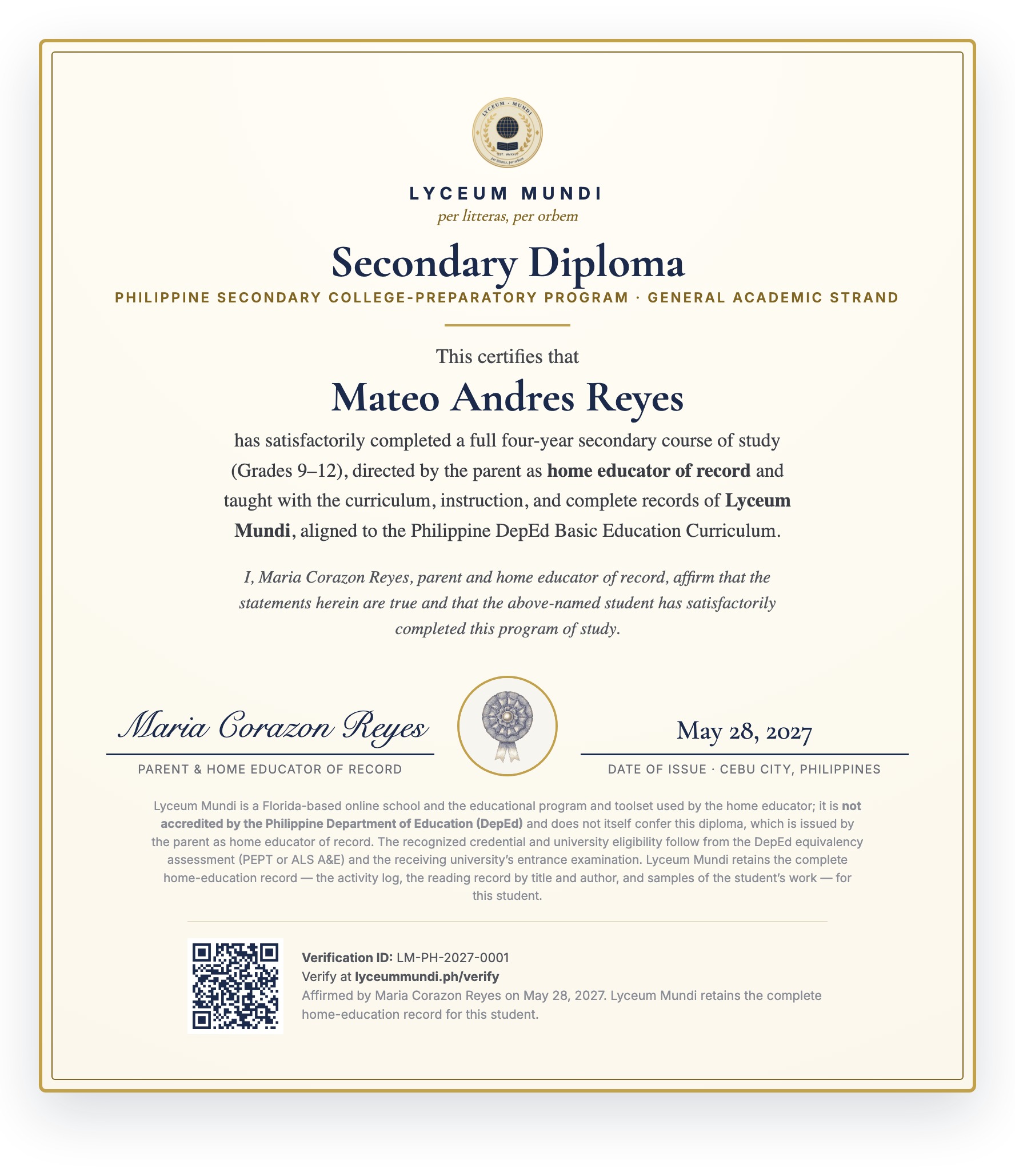
From your console you generate a parent-issued secondary diploma on Lyceum Mundi letterhead, signed by you as home educator of record. It certifies that your child completed a full four-year secondary course of study aligned to the DepEd curriculum, and notes plainly that Lyceum Mundi is a Florida online school, is not DepEd-accredited, and keeps a complete, verifiable record of the work. Paired with a DepEd certificate of rating (PEPT or ALS A&E), it tells a university the whole, honest story.
A matching transcript lists every subject across Grades 9–12 with grades and credits — built as your child goes, and exportable in a click.
This page is educational information, not legal advice, and summarizes Philippine basic-education and homeschooling rules in general terms (RA 10533; DepEd Order No. 1, s. 2022; RA 11510). Lyceum Mundi is not accredited by the Philippine Department of Education and does not confer a DepEd-recognized credential; equivalency and university admission are determined by DepEd and the receiving institutions. For advice on your situation, consult a Philippine attorney or your DepEd division office.
